


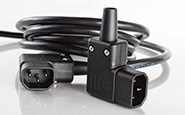
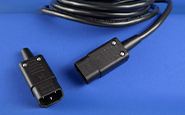



Interpower Connections, June 2009 edition, looks specifically at how to specify international AC inlets, connectors, plugs and outlets, also known as IEC 60320 connections. In this edition of Interpower Connections, we will explain how to specify IEC 60320 connections for use in equipment shipped globally. To also assist you with specifying the correct IEC 60320 connection, Interpower Corporation is offering, for free, our IEC 60320 Appliance and Interconnections Coupler sheet. You can download the coupler sheet as a PDF, print it off and post it or save a copy for future reference. Upcoming editions will take a look at other subjects that we hope will be of interest to both experienced and new designers alike. Should you have a question that Connections has yet to answer, please email us at info@interpower.com.
What is an IEC 60320 connection?
IEC 60320 is a series of international electrical standards specific to “appliance couplers,” or connections, published by the IEC (International Electrotechnical Commission). There are a wide range of IEC 60320 products.
60320-1: Appliance couplers intended for the connection of a supply cord to electrical appliances or other electrical equipment.
60320-2-1 - Sewing Machine couplers: Appliance couplers for sewing machine applications.
60320-2-2: Interconnection couplers for peripheral, accessory power, systems.
60320-2-3: Appliance couplers with a degree of protection against ingress of water higher than IPX0, intended for the connection of the supply cord to portable electrical appliances of class II for household, commercial and light industrial use, typically outdoor use.
60320-2-4: Appliance couplers dependent on appliance weight for engagement.
Furthermore, many countries and regions adopt these standards under their system of standards, and sometimes even rename them, e.g. EN 60320 for Europe. Many of these 60320 products are very familiar to everyday users, but some are less common.
For purposes of this article, we will focus on the more common IEC 60320-1 couplers and IEC 60320-2-2 interconnection couplers.
Explain the different configurations, and the reason there are different configurations
The IEC 60320 couplers are organized by configurations, i.e. different shapes, to ensure proper connections are made safely. All are rated for use up to 250VAC. Therefore, when designers select the proper IEC 60320 coupler system, the end user simply makes the proper connection, since improper connections are prevented by the configuration itself. Selecting the proper configuration involves deciding on the following criteria:
The IEC 60320 AC power inlet is the most commonly used means of connecting a detachable cordset to electrical or electronic equipment that consumes up to 16A/250V at operating temperatures up to 120°C. The devices in IEC 60320 standard sheets C13, C14, C15, C16, C19, and C20 are the most commonly specified standards. IEC 60320-1 connectors carry the odd numbered sheet style designations, and the intended mating inlets are the even numbered sheet style designations immediately following the connector sheet style (e.g. sheet style C13 connector mates to the sheet style C14 inlet). The IEC 60320 system is used throughout the industrialized world. By designing an IEC 60320 power inlet into a product, the manufacturer can attach an international cordset (i.e. cordset with a British, Australian, Continental European, or North American plug) just prior to shipment. This allows the equipment manufacturer to make one device for sale anywhere in the world.
“Cold” Connectors (65°C)
IEC 60320 C13 describes a 10A, 250VAC connector for Class I equipment for cold conditions (65°C measured at the contact).
The 10A rating on power inlet connectors requires that mating international cordsets rated at 10A use the larger 1.00mm² cable. Interpower Corporation’s cordsets utilize the 1.00mm² cable, thus permitting the 10A rating (with the exception of some British cordsets where the rating is limited by the fuse in the plug). The international cordsets in the Designer’s Kit of International Cordsets are rated at 10A.
“Hot” Connectors (120°C)
For applications in which a 10A rating at 65°C is insufficient, IEC 60320 provides for an ac power connector with a 120°C rating, described in standard sheets C15 and C16. This connector includes a key which prevents insertion of the international connector intended for “cold” conditions.
Detachable Connections at 16–20A
IEC 60320 C19 and C20 connectors allow the use of detachable cordsets rated at 16A European and 20A in North America (65°C). While not common, IEC 60320 C23 and C24 offer an ungrounded option. Higher power products, which formerly required the use of permanently attached power cords or hard-wired connections via conduit, can now exploit the convenience of a detachable cordset. A complete cordset for use in North America rated for service to 20A/250VAC could be constructed with the cable-terminated portion of this connector system on one end of a length of 3x12AWG cable. Suitable wall plugs for connection at 120VAC can include the straight-blade NEMA 5-20P or the locking L5-20P. The product that uses a 20A plug in North America can, for export markets, use a Schuko plug, a British plug, an Italian 16A plug, an Australian 15A plug, or the Indian plug on the end of 1.5mm² cable equipped with this IEC connector. For Denmark or Switzerland, whose plugs are only rated at 10A, it will be necessary to use IEC 60309 pin and sleeve devices.
2.5A Applications
The IEC 60320 C5 connectors and C6 inlets have three pins, which include a ground contact. Originally intended for use on sewing machines, this coupler is now used on laptop computers. The presence of a ground at the equipment allows designers to incorporate a high performance RFI (radio frequency interference) filter into the inlet. All C5 connectors must be molded onto cable; rewireable versions are not permitted.
Devices for Class I applications are intended for small grounded electronic and electrical appliances. These parts are considerably smaller than IEC 60320 C13 devices and will be welcome on small applications where panel space is limited. The devices pictured are rated 2.5A/250VAC.
The coupler pair described in standard sheets C7 and C8 is another example of an IEC 60320 configuration with new life. This coupler has no ground contact. C7 and C8 couplers were originally developed for use in devices such as electric razors, radios, and other home entertainment appliances. Now this coupler pair is finding use on laptop computers. In some cases, the power connection is made at the back of the laptop itself. In other cases, it is made via a detached power supply. Also, C7 connectors must be molded onto the power cable; rewireable versions are not allowed.
Devices for Class II applications are intended for small electronic and electrical appliances that are not grounded. These parts are smaller than more commonly specified IEC 60320 devices and will be welcome on small applications in which panel space is limited. back to top
Interpower announces a line of 3-Function Power Entry Modules to their Module family. These 3-function power entry modules combine the functions of a general purpose RFI filter with an IEC 60320 C14 inlet, and either fusing or switch capabilities. These shielded modules are rated from 6–10A and carry UR, CSA and VDE approvals. Interpower offers no minimum order requirements and same day shipments are available for stock item orders received by 6:00 p.m. Central Time. For ordering and technical information, contact our Customer Service Department at 800/662-2290 or order online. back to top

The IEC 60320 AC power inlet is the most commonly used means of connecting a detachable cordset to electrical or electronic equipment that consumes up to 16A/250V at operating temperatures up to 120°C. The devices in IEC 60320 standard sheets C13, C14, C15, C16, C19 and C20 are the most commonly specified standards. Interpower Corporation is offering the IEC 60320 Coupler sheet so you have easy access to what each of these Appliance and Interconnection Couplers looks like. Just click here (http://www.interpower.com/ic/IEC_coupler_sheet.asp ) to view this free coupler page or download a PDF. back to top